I have a friend, a very bright fellow actually, who has a tendency to go through intellectual phases. A couple of years ago, he “discovered” libertarianism, and occasionally got preachy about how we Democrats were as intrusive as the Republicans, with our “nanny state.” It became a recurring theme of our conversations for me to rib him about his opposition to fire stations. (I  think he was mainly excised about government prohibition of his preferred method of relaxation, and am happy to note he no longer is that hostile to us. Bush 43 taught him the folly of protest votes.)
 think he was mainly excised about government prohibition of his preferred method of relaxation, and am happy to note he no longer is that hostile to us. Bush 43 taught him the folly of protest votes.)
Current Republican hostility to government, on the other hand, seems to know no bounds. A more sensible generation of Republicans like Eisenhower, Rockefeller, and even Nixon maintained a healthy skepticism about government programs. That skepticism and vigilance, in our Constitutional structure, forced progressive Democratic programs to be designed and run in a more cost-effective manner. At the end of the day, these Republicans were pragmatists; Nixon sought to fine-tune Johnson’s Great Society, not abolish it.
Then came Reagan. The Party of Slow became the Party of No.
You would think that simple concerns of electoral viability would moderate those impulses. But you would be wrong.
No, there is not in fact a bill entitled the “Kill Alabamians Act of 2011.” It is known as HR1, and is somewhat more innocuously titled as the Full-Year Continuing Appropriations Act, 2011. This is the linchpin of the budget debates, and shutdown threats, about which you have been reading in
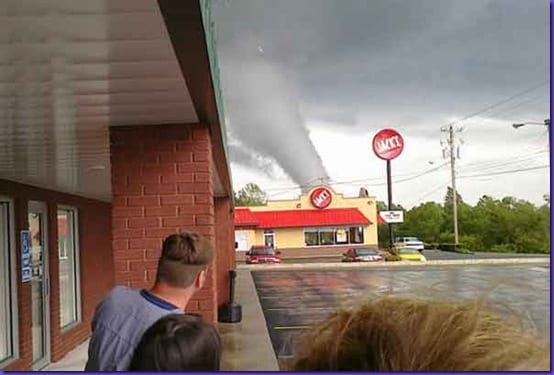 the news. Among its provisions is one that, had it been in effect a few years earlier, could have turned the horrible-enough tornadic events of Wednesday, April 27, 2011, into something so much worse, it barely bears contemplating.
To appreciate this, you have to look back to the newscasts and weather reports of the 48 to 72 hours before the devastation erupted. Forecasts were calling for strong storms that long before catastrophe hit. Then, hours before the actual onslaught, the National Weather Service issued a rare “high risk” warning that put the entire state of Alabama on a war footing. Schools canceled classes and sent children home, people turned on their radios and televisions, and everyone from the governor to volunteer firemen and Red Cross volunteers began leaning in the right direction to respond more promptly to what eventually transpired. Those preparations saved countless hundreds of lives.
Many things make those life-saving warnings possible. Supercomputers crunch weather data at a rate that
makes my head spin to contemplate. Research has greatly improved the mathematical models the computers use. But all the computers and all the formulae are worthless without the proper data to process. And a very large part of that data comes from weather satellites, which can track and measure atmospheric conditions everywhere and continuously, without relying on infrequent updates from discrete reporting stations.
Satellites, unfortunately, are like your car, or your microwave oven. They wear out or break down. In the case of geosynchronous satellites, they run out of the maneuvering fuel necessary to maintain their orbiting station. In other words, they have to be replaced. That replacement, of course, involves the expenditure of government funds.


 Which is where Representatives Roby, Brooks and Aderholt (along with the remaining Republican members of Congress from Alabama) come in. To a man and woman, they voted for HR1. You will recall that the GOP House has insisted that the continuing
  esolution contain deficit-reducing cuts, as the Bush tax breaks for billionaires are considered sacrosanct. One of those cuts is that of a $700,000,000 program to replace the aging and failing weather satellite fleet of the National Weather Service. An expenditure that amounts to a couple of bucks for each person in America. When an EF-4 tornado (which may be upgraded to EF-5) passed within about 4 miles of me last week, killing over 30 people, I was at home, in a central hallway, not on the road as I might have been at that hour. I had put a fresh battery in my NOAA weather radio (and even it
succumbed that night to the continuous alarms sounded). Was that “high
risk” warning hours earlier worth two bucks to me? Would the average
voter think it was worth two bucks to him? To quote a fast-falling star
of the GOP, “you betcha!”
esolution contain deficit-reducing cuts, as the Bush tax breaks for billionaires are considered sacrosanct. One of those cuts is that of a $700,000,000 program to replace the aging and failing weather satellite fleet of the National Weather Service. An expenditure that amounts to a couple of bucks for each person in America. When an EF-4 tornado (which may be upgraded to EF-5) passed within about 4 miles of me last week, killing over 30 people, I was at home, in a central hallway, not on the road as I might have been at that hour. I had put a fresh battery in my NOAA weather radio (and even it
succumbed that night to the continuous alarms sounded). Was that “high
risk” warning hours earlier worth two bucks to me? Would the average
voter think it was worth two bucks to him? To quote a fast-falling star
of the GOP, “you betcha!”Simply put, without the irreplaceable data provided by these satellites, the National Weather Service, within a few short years, will be deprived of the ability to make the sort of predictions that saved countless lives last week. With those warnings, we mourn hundreds, but we could have been mourning a thousand or more. Any member of Congress who voted to subject voters to this risk, and any political party that so advocated, should be made to pay the political price for it. No one can say when, or exactly where, but within a few years, people will lose their lives to tornadoes because Representatives Roby, Aderholt and Brooks thought that tax breaks for their multimillionaire supporters were more important than the safety of their constituents.
 That is almost a mathematical certainty. I shouldn’t even have to mention that accurate weather forecasts are of extreme value and importance to American troops, sailors and airmen fighting around the world.
There will be voices that will say we must not “exploit” the tragedy of April 27 for political ends. We can be sure that the first mention of these irresponsible votes will garner squeals of “exploitation!” and “politics!” from the other party. To be sure, the issue must be discussed in a manner that respects the feelings of those who have lost homes and loved ones. “Bloody shirt” visuals are not necessary to make the point, and would not be appropriate. But it would be a greater disservice to those who suffered loss not to raise the issue, and raise it forcefully.
As to precedent, there is only one issue a society debates that is more important than quotidian public safety, and that is the decision to go to war. I do not have to remind any reader of the absolute politicization of the War on Terror that Bush, Cheney and Rove deployed in the 2002 and 2004 elections. Any Democrat, regardless of his or her record, was subjected to accusations of cowardice, disloyalty, and incompetence. Write letters to the editor calling these members of Congress, and their party, to answer for their votes. Come 2012, some negative paid media is in order. We cannot let them get away with hamming it up before TV news cameras and expressing their “concern” for tornado victims, while casting votes that assure there will be hundreds more of them in the future.

Lest anyone think this is a “regional” argument only applicable in North Alabama’s Tornado
 Alley, we mustn’t forget that accurate weather forecasts are a vital interest of the other end of the state, including the GOP stronghold of Baldwin County.
More on the disaster of Republican disaster philosophy in my next post.