There are basically two ways to improve the electoral performance of a party - in other words, to win an election. The first of these is to persuade voters to vote for your party. The second is to persuade more of the voters who are already persuaded to vote for your party, but who would not vote without the extra prod of some “turnout” effort, to show up and vote. This much, you don’t have to read this blog to know. For some time, the strategy of the Alabama Democratic Party has been centered on the former. Efforts to do the latter have historically been limited to localized efforts in the African-American community.
The typical Democratic campaign of recent years has consisted of collecting large sums of money from a small handful of groups: AEA, the plaintiff’s bar (i.e., “trial lawyers”), that part of the gaming industry that prefers creating jobs in Alabama to creating jobs in Mississippi, and to a lesser extent organized labor. This money was then spent - not always effectively - mostly on television ads for individual candidates. While we did do some effective negative campaigning, which has been shown to be effective by both professional experience and academic studies, most of our negative was focused on individual Republican candidates. In the meantime, our better-financed opposition added a generous dose of “party negative” to their mix, painting every Democrat as an abortion-supporting, gay-loving, God-hating, gun-seizing acolyte of the conservative bete noir of the cycle. This was, of course, reinforced by channels other than paid media, such as talk radio and thousands of “apolitical” pulpits and “Christian voter guides.” Whatever its merits (and I have written elsewhere about the need for party-based positive and negative media), this has clearly been a persuasion-oriented strategy.
Beginning in the 1990’s, and culminating in the 2010 loss of the Legislature and every statewide race, this strategy became less and less effective. Not only has the strategy been shown to be ineffective, it is becoming increasingly impossible to maintain. The Legislature has shown that it
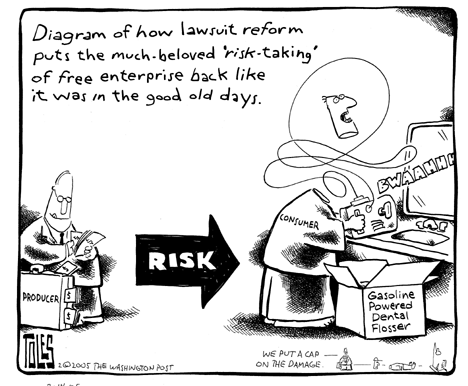 is determined to frustrate AEA’s constitutional right to collective political action by any means necessary, and we can no longer count on their historical level of financial support. The plaintiff’s bar has been victimized by a decade of Republican Supreme Court control. When the Alabama Supreme Court says it’s OK for a corporation to make a deadly product without paying damages, or for a bank to lie about its loans and investments, those lawyers don’t collect judgments. From those judgments come their fees, and from those fees their historic support. To the extent these lawyers have tried to hedge their bets by contributing to Republicans, they have been rewarded with ... more “tort reform.” As to the gaming industry, we all know what’s happened there.
This is the point at which we have to ask ourselves whether we Alabama Democrats have a turnout problem that has contributed to our electoral reversals. There are several ways to answer this question. “Yes.” “Si.” “Ja.” “Oui.” “Да.”
In my last post, I looked at some of the margins in the 2010 Alabama House races. Here, I want to shift perspective to the total vote turnout in each of the 105 districts, and compared it to the Republican percentage of the vote in each district. The results are reflected in this chart:

This chart shows a compelling correlation between the total number of votes cast, and the percentage of the vote taken by the Republican candidate. The two trendlines representing the figures for the contested races stand, taken together, at almost a perfect-correlation 45º angle.
Keep in mind, this chart is showing total vote, not percentage of registered or eligible voters voting, on the Y axis. Varying rates of voter registration, or shifts in population between the 2000 Census on which the 2010 districts were based, could produce a slightly different result. However, low registration rates are just as indicative of an organizational problem as low turnout rates. As to possible effects of demographic shifts, while final 2010 Census results aren’t out, it seems evident so far that Alabama didn’t experience the intensive growth in white suburban areas, and depopulation of black counties and neighborhoods, that it did in each of the preceding three decades. Total vote, in roughly equal-population districts, is a workable rough metric of turnout. A correlation this strong isn’t going to be significantly altered by accounting for these variables, and the operational consequences of the numbers reflected are still significant.
Clearly, we could have won several close House races by boosting turnout: identifying likely Democratic voters, and giving them whatever encouragement and assistance was necessary to get them to the polls. Focused turnout efforts work. Could we have retained control of the House (and presumably the Senate)? That would have been a tall order in 2010’s atmosphere, but we clearly could have held enough seats to deprive the Republicans of their filibuster-proof present majorities. This alone would have made an upgrade in the turnout game worthwhile.
 More troubling is a set of numbers, represented on this chart by the vertical arrays of red and blue dots at the 100% and 0% GOP votes, respectively, on the X axis. These represent the 30 districts in which the Republican nominees were unopposed, and the 29 districts in which Democratic nominees were unopposed. The quickest use of the Mark I Eyeball statistical analyzer will show that there were more votes cast for unopposed Republicans than for unopposed Democrats. A lot more. Specifically, the 30 unopposed Republicans got a total of 389,012 votes, an average of 12,970; while the 29 unopposed Democrats trailed with 263,232, an average of 9,077.
Why should this trouble us? After all, we weren’t going to win many of those House seats anyway, right? The problem is, these numbers, both in the Democratic and Republican districts, probably almost entirely reflect straight party voting. While this would require detailed analysis of precinct-level results in those limited counties whose machines separately report straight ticket votes for verification, common sense tells us this is so. It’s a little difficult (though well worth the trouble) to vote. Almost no one is going to go to that trouble just to vote for their cousin/neighbor/deacon, the Representative, and not bother with the rest of the ballot. This is particularly true in the case where that Representative is unopposed - why bother? For decades, knowledgeable political observers have zeroed in on uncontested races as a rough measure of straight-ticket voting.
 Given this, these numbers have significance both above and below the Legislature on the ballot. They reflect a serious shortcoming on the part of the Party in identifying and turning out Democratic voters. How serious? If each of the unopposed Democratic House members had averaged the same 12,970 votes as the unopposed Republicans, unopposed Democrats would have received, in the aggregate, 112,987 more votes, the vast majority of whom would have been straight ticket Democratic votes. For those with short memories, Jim Folsom, Jr., only lost his re-election bid for Lt. Governor by 46,009 votes. I am willing to wager that at least some local races were lost in these underperforming districts.
I also want to make one thing clear: I am not pointing out the Democratic Representatives in whose districts these shortcomings happened. While I do know one or two of them whose contribution to the Party effort leaves something to be desired, by and large voter identification and GOTV is a Party function, not that of an individual candidate. I am merely using House districts as a convenient and useful metric. The shortfalls were also noticeable in those districts with contested races. On a related note, I am not one of those Democrats who try to complain that the reason for our defeat was that “the blacks didn’t get their vote out.” In fact, of the 29 unopposed Democrats, six were white candidates in white-majority districts, and five of those six were in the lower half of the unopposed Democrats, in total votes received.
 Fortunately, this is one area where the Alabama Democratic Party is on the ball. Under the leadership of Judge Kennedy, and Executive Director Bradley Davidson, the Party has undertaken a major voter identification project. This effort seeks to reach most voters before the 2012 election, and virtually all voters before 2014, to identify the partisan leanings (or independence) of each voter. The Party will then be in a position to target GOTV efforts on Democratic voters, and improve the dismal turnout statistics reflected in the above table. (We will also be able to target undecided voters with persuasive messaging!) This is something the Alabama Republican Party has been doing for nearly a decade now, in a very intense, well-funded and organized effort, and the past disparity in these efforts goes a long way toward explaining the results in 2012. For those who want to get involved, the Party website has a page devoted to the training sessions being offered. If you never get involved in another Democratic campaign effort, this is the one to join. It is going to change the face of Alabama politics, and for the better.
 As long ago as the proto-democratic Athenian constitution of Draco (c. 650 B.C.E.), citizens were fined for failing to appear at the sessions of the Assembly to vote. A number of modern democracies follow the same practice. The United States does not, and should not, follow this practice. But voter apathy is a problem, and it’s particularly a problem when the Republicans are doing more about it than Democrats.