Showing posts with label Aderholt. Show all posts

Friday, May 6, 2011

Roby, Aderholt, and Brooks Vote for Kill Alabamians Act of 2011

I have a friend, a very bright fellow actually, who has a tendency to go through intellectual phases. A couple of years ago, he “discovered” libertarianism, and occasionally got preachy about how we Democrats were as intrusive as the Republicans, with our “nanny state.” It became a recurring theme of our conversations for me to rib him about his opposition to fire stations. (I think he was mainly excised about government prohibition of his preferred method of relaxation, and am happy to note he no longer is that hostile to us. Bush 43 taught him the folly of protest votes.)

Current Republican hostility to government, on the other hand, seems to know no bounds. A more sensible generation of Republicans like Eisenhower, Rockefeller, and even Nixon maintained a healthy skepticism about government programs. That skepticism and vigilance, in our Constitutional structure, forced progressive Democratic programs to be designed and run in a more cost-effective manner. At the end of the day, these Republicans were pragmatists; Nixon sought to fine-tune Johnson’s Great Society, not abolish it.

Then came Reagan. The Party of Slow became the Party of No.

You would think that simple concerns of electoral viability would moderate those impulses. But you would be wrong.

No, there is not in fact a bill entitled the “Kill Alabamians Act of 2011.” It is known as HR1, and is somewhat more innocuously titled as the Full-Year Continuing Appropriations Act, 2011. This is the linchpin of the budget debates, and shutdown threats, about which you have been reading in the news. Among its provisions is one that, had it been in effect a few years earlier, could have turned the horrible-enough tornadic events of Wednesday, April 27, 2011, into something so much worse, it barely bears contemplating.
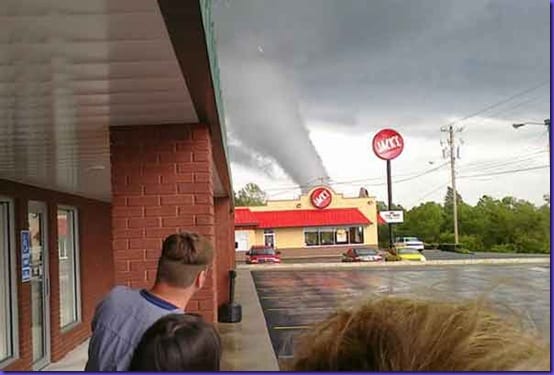
To appreciate this, you have to look back to the newscasts and weather reports of the 48 to 72 hours before the devastation erupted. Forecasts were calling for strong storms that long before catastrophe hit. Then, hours before the actual onslaught, the National Weather Service issued a rare “high risk” warning that put the entire state of Alabama on a war footing. Schools canceled classes and sent children home, people turned on their radios and televisions, and everyone from the governor to volunteer firemen and Red Cross volunteers began leaning in the right direction to respond more promptly to what eventually transpired. Those preparations saved countless hundreds of lives.

Many things make those life-saving warnings possible. Supercomputers crunch weather data at a rate that
makes my head spin to contemplate. Research has greatly improved the mathematical models the computers use. But all the computers and all the formulae are worthless without the proper data to process. And a very large part of that data comes from weather satellites, which can track and measure atmospheric conditions everywhere and continuously, without relying on infrequent updates from discrete reporting stations.

Satellites, unfortunately, are like your car, or your microwave oven. They wear out or break down. In the case of geosynchronous satellites, they run out of the maneuvering fuel necessary to maintain their orbiting station. In other words, they have to be replaced. That replacement, of course, involves the expenditure of government funds.

Which is where Representatives Roby, Brooks and Aderholt (along with the remaining Republican members of Congress from Alabama) come in. To a man and woman, they voted for HR1. You will recall that the GOP House has insisted that the continuing esolution contain deficit-reducing cuts, as the Bush tax breaks for billionaires are considered sacrosanct. One of those cuts is that of a $700,000,000 program to replace the aging and failing weather satellite fleet of the National Weather Service. An expenditure that amounts to a couple of bucks for each person in America. When an EF-4 tornado (which may be upgraded to EF-5) passed within about 4 miles of me last week, killing over 30 people, I was at home, in a central hallway, not on the road as I might have been at that hour. I had put a fresh battery in my NOAA weather radio (and even it succumbed that night to the continuous alarms sounded). Was that “high risk” warning hours earlier worth two bucks to me? Would the average voter think it was worth two bucks to him? To quote a fast-falling star of the GOP, “you betcha!”

Simply put, without the irreplaceable data provided by these satellites, the National Weather Service, within a few short years, will be deprived of the ability to make the sort of predictions that saved countless lives last week. With those warnings, we mourn hundreds, but we could have been mourning a thousand or more. Any member of Congress who voted to subject voters to this risk, and any political party that so advocated, should be made to pay the political price for it. No one can say when, or exactly where, but within a few years, people will lose their lives to tornadoes because Representatives Roby, Aderholt and Brooks thought that tax breaks for their multimillionaire supporters were more important than the safety of their constituents. That is almost a mathematical certainty. I shouldn’t even have to mention that accurate weather forecasts are of extreme value and importance to American troops, sailors and airmen fighting around the world.

There will be voices that will say we must not “exploit” the tragedy of April 27 for political ends. We can be sure that the first mention of these irresponsible votes will garner squeals of “exploitation!” and “politics!” from the other party. To be sure, the issue must be discussed in a manner that respects the feelings of those who have lost homes and loved ones. “Bloody shirt” visuals are not necessary to make the point, and would not be appropriate. But it would be a greater disservice to those who suffered loss not to raise the issue, and raise it forcefully.

As to precedent, there is only one issue a society debates that is more important than quotidian public safety, and that is the decision to go to war. I do not have to remind any reader of the absolute politicization of the War on Terror that Bush, Cheney and Rove deployed in the 2002 and 2004 elections. Any Democrat, regardless of his or her record, was subjected to accusations of cowardice, disloyalty, and incompetence. Write letters to the editor calling these members of Congress, and their party, to answer for their votes. Come 2012, some negative paid media is in order. We cannot let them get away with hamming it up before TV news cameras and expressing their “concern” for tornado victims, while casting votes that assure there will be hundreds more of them in the future.

Georgia Democratic Senator Max Cleland, a triple amputee from the Vietnam War, was the subject of 2002 ads pairing his picture with those of bin Laden and Saddam Hussein; he was narrowly defeated by Republican Saxby Chambliss. If the Republicans do not hesitate to engage in tasteless lies, we must not hesitate to make forceful, truthful arguments about their records. Perhaps not this week, but throughout the remainder of the spring tornado season, we should all make this point.

Lest anyone think this is a “regional” argument only applicable in North Alabama’s Tornado Alley, we mustn’t forget that accurate weather forecasts are a vital interest of the other end of the state, including the GOP stronghold of Baldwin County.

More on the disaster of Republican disaster philosophy in my next post.

Tuesday, July 6, 2010

Conventional Stupidity: The 4th Congressional District

The other day, I vented for a few minutes about the “Conventional Wisdom” as it pertains to the Fifth Congressional District. Actually, I vented for a lot longer than that; I just quit typing before I wrote something about the exponents of “Conventional Wisdom” that might get me in legal trouble. Today, I am going to tempt the fates again, and talk about how “Conventional Wisdom” has inflicted long-standing Republican control on a fundamentally Democratic Congressional district. Perhaps there are lessons to be learnt by the DCCC, that can avoid a similar episode of incompetence in the Fifth this year.

As the title gives away, I am talking about the Alabama Fourth District. This district has been held since the 1996 election by Republican Robert Aderholt of Haleyville. Aderholt is noted for being one of the most reliable votes in the GOP Caucus, so much so that he has failed, time and again, to bargain for goodies for his constituents. Indeed, he has frequently voted them out of a job, as with his deciding vote favor of CAFTA in 2005 that spelled the end of literally thousands of hosiery mill jobs in Fort Payne, that were lost to Central American competition. Whatever caused the change in hairlines in the two photos here (the one on the left, from his first campaign; the other current), it wasn’t from excessive activity underneath.

Because Aderholt was allowed to become entrenched in this district, it is widely viewed, especially among the Beltway-genius crowd, as one of the most reliably Republican districts in the country. This reputation is bolstered when, as this year, no Democrat qualifies for the contest. However, the district is Republican in the first place because that same Beltway Conventional Wisdom became a self-fulfilling prophecy in 1996. Before that year, the district had been held for 30 years by Democratic legend Tom Bevill of Walker County. Bevill had reclaimed the seat for the Democrats after its one term in GOP hands after the 1964 Goldwater surge in Alabama. Prior to that one term, the seat had been Democratic since 1901, and even that one-term Republican interval was occasioned by GOP control of the Congress, which seated Republican William Aldrich (as in Nelson Aldrich Rockefeller) under questionable circumstances.

Bevill was a master of the appropriations process, and spent all but the last of his last several terms as chair of the House Public Works Appropriations Subcommittee, the best seat in Congress for bringing bacon back home to the district. Aderholt, by contrast, strikes most observers as an acquiescent bobble-head who can’t find sufficient words to reassure the Republican leadership, and a Republican president when he has one, that he is their most reliable team player. Bevill was a genius at leveraging either issue concessions, or benefits for his district, by hinting that he was getting a lot of heat from his constituents about a bill, and might have to vote against it. (All without sacrificing core Democratic values.) Not so Aderholt. A district accustomed to considerable largess under Bevill has become one of the doormats of Federal appropriations as a result. Bevill’s mastery of the process is exemplified by a speech I recall at his district retirement dinner in his hometown in 1996. One of the speakers was a Corps of Engineers representative, who said she stopped a local policeman to ask for directions to “The Bevill Center,” the venue for the dinner. The cop scratched his head and asked her, “Which one?”

One reason this district is said to be permanently Republican is its voting history since Aderholt was elected in 1996. Now, for the strength to resist calling expositors of Conventional Wisdom what they really, truly are. The district is “Republican” because Aderholt has averaged 67.7% in his seven elections to the seat. Yet, when Aderholt first sought the seat, Bevill had averaged 91.7% in his last seven elections. This graph shows the relative strengths of the two in their last seven elections:


The point of my gripe - no, my fury - is that, in 1996, Democratic nominee, former State Senator Bob Wilson of Walker County, was denied funds from the DCCC (a nominal media buy that had been promised was pulled in favor of “more competitive” districts) on the basis that the district was “too Republican” for the DCCC to “waste” scarce resources - despite the fact its then-recent voting history was more Democratic than the now-Republican history used to write it off. This was being done while the national Republican Party, through PACs, party committees, and guided contributions, was channeling hundreds of thousands of dollars that cycle to Aderholt to take the seat. It is bad enough when such nonsense is propagated by Beltway punditry, but when it originates in the campaign offices of the Democratic Party, one wonders if a treason investigation isn’t merited. After Wilson, two strong Democratic candidates contested the seat before Aderholt could plant deep roots - Don Bevill, the former Congressman’s son, in 1998, and Marsha Folsom, the wife of Lt. Gov. Jim Folsom (then the former Governor) in 2000. Both had entered the race with promises of national party support, which, in both cases, was not forthcoming. Conventional Wisdom, you see, again said the seat was “too Republican.”

And I can hear the New Jersey-American accents pointing out to me, that “tings have changed,” that voters in the Fourth will “no longer vote for a Democrat in the age of Kerry and Obama.” Obama, personally, I concede, is a problem. The racial voting polarization was extreme in this district which, with only a 5.1% black vote, is Alabama’s whitest. Obama got 23.7% in DeKalb County, 21.3% in Marshall, and only 16.7% in Cullman. Overall, McCain got 76.2% of the district’s vote. (But since Bush only got 60.2% in 2000, it may be safe to assume the size of that margin is attributable to racial, not political, factors.) Neither have other Democratic Presidential candidates fared well in the district. However, one appears to be disqualified from status as a DC pundit if one knows that, especially in the South, GOP Presidential voting patterns are not always followed downballot. This is empirically established by the following table, which aggregates the 2006 party votes for those districts in the Alabama House of Representatives which are fully nested within the Fourth District:


PartySeats HeldTotal Vote% Vote
Democrats1194,39262.1%
Republicans357,64537.9%

Without taking time to likewise tally courthouse offices, anyone with enough familiarity with the district to have an opinion worthy of audience, knows that the county offices in this District are overwhelmingly Democratic. In fact, Democrats control the majority, if not all, of the courthouse offices except in historically Republican Winston County (a county whose Republicanism dates to Abe Lincoln; it attempted to secede from the state during the Civil War). Even in Marshall County, where Republican trends have been strongest in the district, Democrats still control the sheriff’s office and the probate court, two traditional local power centers. So, I don’t care if your name is “Cook,” or “Rothenberg,” or “Kowalski.” If you try to tell me that this district will not vote for any Democrat downballot because it votes Republican in Presidential elections, I am not paying the $200-$300+ a year you charge for your insider “knowledge.” I can put the cash to better use.

Wow, that felt better. And I managed to say what I wanted without using any of what Dennis the Menace called his dad’s “golf words.” Which leaves me in enough of a charitable and relaxed mood to observe that the performance of the DCCC in Southern districts has notably improved, as shown by their heavy presence in the Alabama Fifth in 2008. (I sense the gentle nudge of the boot of Howard Dean, implementing his successful 50-State Strategy over the objection of Conventional Wisdom insiders, who remain convinced we can elect a President and Congress with only New York and New Jersey.) So long as the Party maintains this 50-State Strategy, this district will be less of a challenge, even in Presidential years. When it was lost in 1996, the Clinton-Gore media buy in Alabama was exactly zero; Clinton lost the state by 6.9%. Had that margin been trimmed by a couple of points by some negative on Dole, this district would probably have still been Democratic today. Perhaps, when this district comes open, there will be some enlightened staffer who will realize the pickup opportunity this district represents.

And that day may not be far off. Rumors keep bubbling around the district - though never covered by the media - that Aderholt is looking for a parachute, preferably golden. Of course, there were more parachutes when there was a Republican in the White House, but the tales persist. (One wonders if the Obama political shop is sufficiently astute to see the possibility of something like the appointment of John McHugh, the Republican from the New York 23rd, as Secretary of the Army. Probably not. That appointment caused a special that elected that district’s first Democrat in 150 years.) It may be that Aderholt is waiting to see if the GOP can take the House back this time. A review of Aderholt’s May 12 FEC report shows that, through that date in this cycle, he has not made a single contribution to a candidate of his own party, and isn’t engaging in the sort of fundraising that intraparty support requires. That is not the behavior of a Congressman who wants to hang around, and thereby must grease the rails of his career advancement on the Hill. (And even I refuse to attribute that course entirely to his naïveté.) A smart local politician, or clever DCCC staffer, will keep one peeled eye on this district at all times.

In the meantime - and I almost dare not ask it - is this district winnable before Aderholt tires of life on the Potomac? The local voting fundamentals say yes, but realism dictates skepticism. Had the DCCC of 1998-2000 been on the ball, it was easily doable. Today, Aderholt has spoken, as the incumbent, at a lot of Rotary lunches and high school graduations. Many Congressional “statements” advocating heterosexuality, private ownership of automatic weapons, and the birth of unwanted babies, have been duly “reported” in local newspapers. A lot of voters over the age of 60 in 1996, who would remember what an effective Congressman can do, are no longer among the living. Still. It’s a little more than “a fella can hope, can’t he?” A close look at the voting trends above show that Aderholt has not performed particularly brilliantly against token, if noble, opposition. A review of returns in his, and other, races, indicates that the district has about a 25% straight-Democratic-ticket voting cohort; not bad for a 91% white Southern district. The overall trend of Aderholt’s vote share is downward (though it will rise with no opponent this cycle). A review of his expenditures this cycle reflects a lack of spending discipline, and a lot of funds expended for items of questionable political benefit. (e.g., repeated “staff lunches” at Ruth’s Chris Steak House; Ribeye, $37.00. Baked potato? $8.00 extra.) His cash on hand on May 12 was only $345,409.00, which, even by House standards, isn’t going to get him in the Richard Shelby Impervious Wall of Cash Club. Perhaps most importantly, he has issue vulnerabilities (see, 4,000 unemployed Fort Payne sock mill workers, supra), that could be exploited by an opponent.

Of course, a successful challenge presumes a successful challenger. I have some names in mind, but various more pressing political issues preclude me from dropping them. You know who you are, and when and if the opportunity presents itself, I will gleefully extol your viability to the world. In the meantime, a few thoughts about such a candidate. He or she will need some pre-existing name recognition, whether from politics, business, or elsewhere, simply to overcome Aderholt’s structural advantages as an incumbent. This race is going to require a lot of money to win. At a minimum, it requires media buys in the Huntsville and Birmingham television markets, and generally, Columbus, Mississippi. The candidate will need either the ability to self-finance, or an ironclad commitment from the DCCC, to the tune of several hundred thousand dollars. (A third possibility is some “Fairy Godmother” donor base, such as the Brown schoolmates who did so much to boost Josh Segall’s campaign in 2008, or Terri Sewell’s tap of her Princeton and Harvard Law buddies.) The balance could be raised once some negative goes up on Aderholt, and challenger viability is established. On issues, the candidate will need to be able to articulate the damage done to the pocketbooks of the district’s rural and small-city blue collar workers by Aderholt’s Republican non-ideas, with relentless discipline and ruthlessness. The task is not impossible, only arduous. But then, we are meant to earn our bread by the sweat of our brows. Unless, of course, we are Republicans.